Ordering an apron for one person is a quick decision: try a couple on, keep the one that hangs right, and move on. Ordering a hundred for a working crew is a different task. You are buying for a range of body types, for shifts that last eight or ten hours, and for jobs that punish a bad fit in different ways. Get the sizing wrong and you end up with a stack of aprons that ride up on tall staff, swim on smaller ones, and get quietly abandoned on a hook. This guide walks through how to specify custom apron sizing for a whole team, and how to read the numbers on a blank supplier’s spec sheet before you commit to a run.
The two measurements that actually decide fit
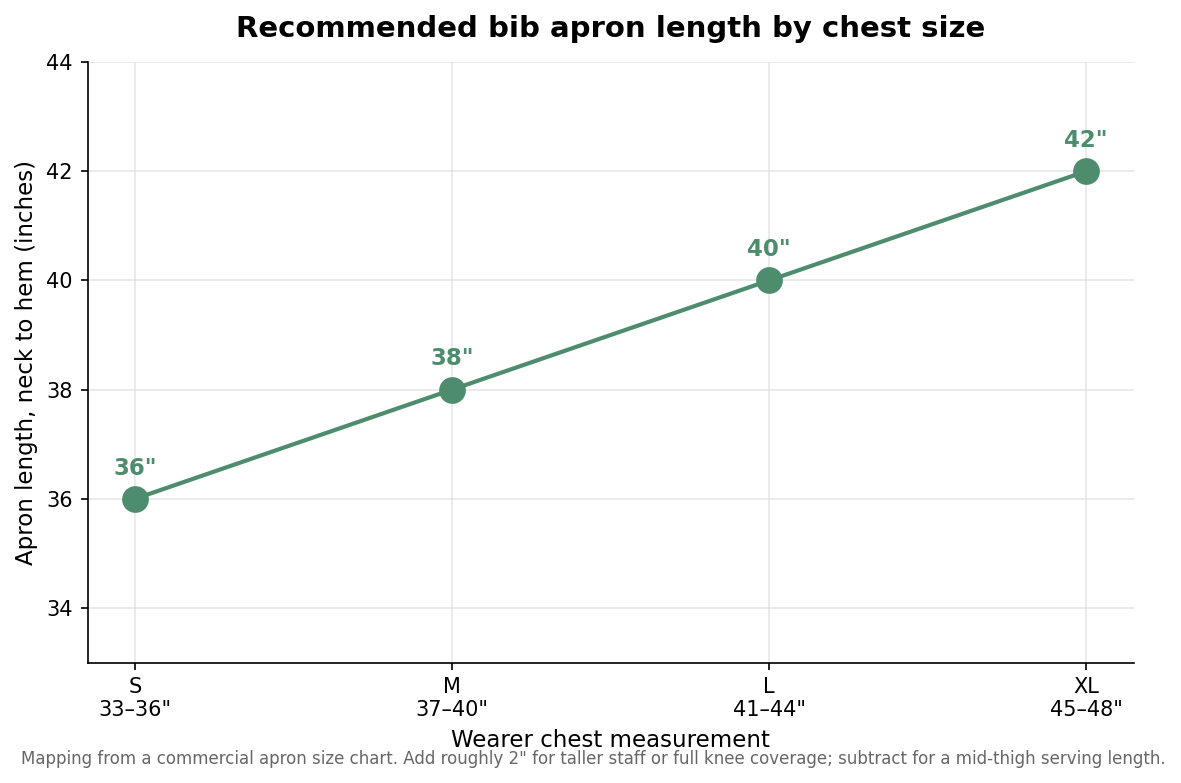
Chest and drop length do most of the work. For a bib apron, fit is governed by where the top of the bib sits and how far the body panel hangs. Measure the fullest part of the chest to choose a width that wraps without gaping, and measure from the collarbone down to wherever you want the hem to land. A widely used sizing table maps a 33 to 36 inch chest to a 36 inch apron, 37 to 40 inches to a 38 inch apron, 41 to 44 inches to 40 inches, and 45 to 48 inches to a 42 inch apron. Those figures are neck-to-hem worn lengths, which is the number that matters to the person wearing it.
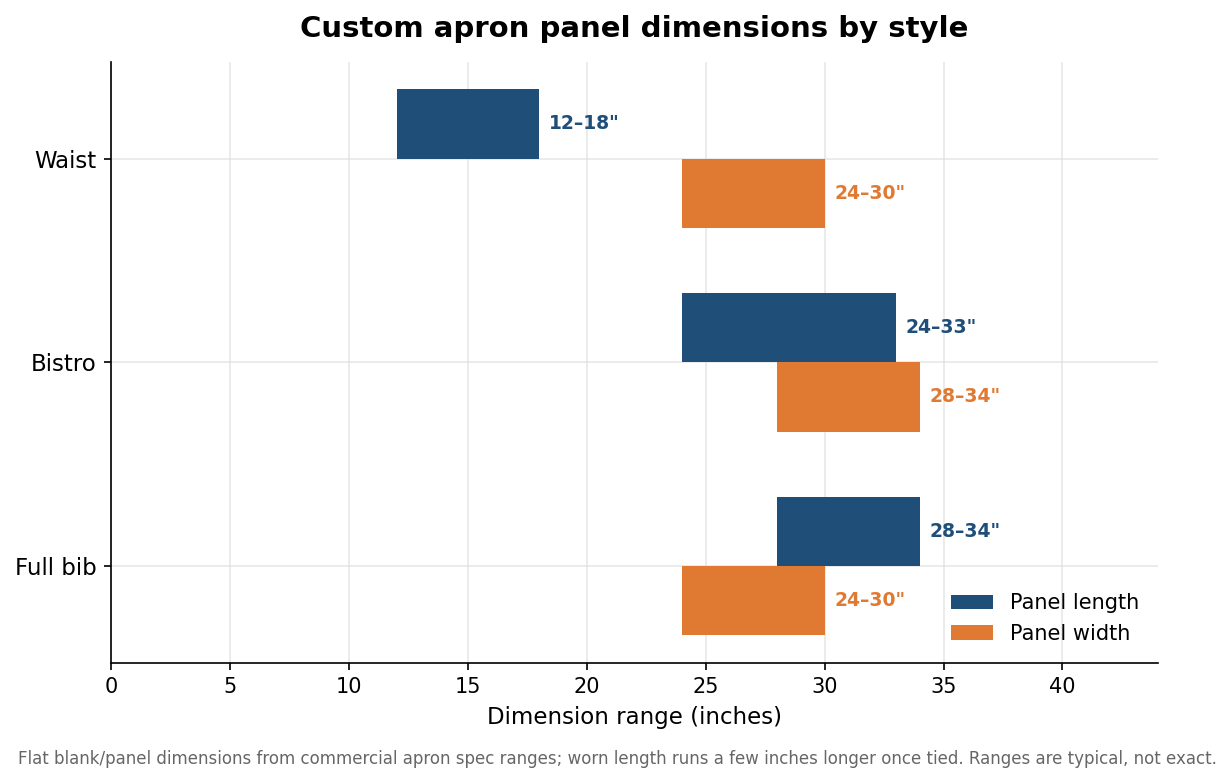
Here is the catch that trips up most first-time buyers: the length on a blank supplier’s spec sheet is usually the flat panel length, measured from the top of the bib to the bottom hem with the apron laid out. That runs shorter than the worn, neck-to-hem length because the neck strap adds height above the panel. So a panel listed at 28 to 34 inches is not the same measurement as the 36 to 42 inch worn lengths in a size chart. When you compare quotes, confirm which convention each supplier is quoting so you are not comparing a flat panel against a worn length.
Match length to the job, not just the body
Coverage is a function of the task, not only the wearer. Line cooks, butchers, and dish crews take splashes and want protection down to the knee, which points to a full bib in the 34 by 34 inch panel range. Servers and baristas move constantly, reach across counters, and need their legs free, so a bistro apron in the 24 to 33 inch length range or a waist apron at 12 to 18 inches keeps them mobile. The trade-off is simple to state and easy to forget: every extra inch of length adds protection and subtracts mobility, and the right point on that scale is different for a grill station than for a floor server.
This is why a single apron length rarely serves a mixed operation well. A restaurant that puts the same 34 inch bib on its kitchen and its floor will find the servers hiking it up or trading it out. Specify by role first, then size within each role.
What the panel numbers mean for each style
Bib aprons typically run 28 to 34 inches long and 24 to 30 inches wide. Width here decides how far the panel wraps toward the hips and how much side coverage a cook gets when they turn to a hot surface. Bistro aprons are the wider style, roughly 24 to 33 inches long and 28 to 34 inches wide, cut to wrap around the waist and overlap at the back for a tailored look on the floor. Waist aprons are the shortest at 12 to 18 inches long and 24 to 30 inches wide, built to carry a guest check, a pen, and a bottle opener rather than to protect clothing. Reading these three ranges side by side, as in the chart above, makes it clear why the styles are not interchangeable even before you factor in fabric or pockets.
Necks, ties, and the one-size question
Adjustability is what lets a small number of sizes cover a range of bodies. On a bib apron, an adjustable neck is the single most useful feature for a team: a slider buckle or D-ring lets a five-foot-two host and a six-foot-three cook wear the same panel at a comfortable height. Where budget allows, cross-back straps spread the load across the shoulders instead of hanging it off the neck, which is a real comfort difference over a long shift and worth specifying for kitchen roles. Waist ties should be long enough to wrap to the front and knot on staff of every size; a common request is ties in the 30 inch-plus range so larger wearers are not left with a stub to tie.
Waist and bistro aprons are genuinely close to one size fits most, because they cinch at the waist and forgive a wide range of bodies. Bib aprons are not. For a bib order covering a full team, plan on offering two or three lengths rather than betting on one. A practical split is a regular length plus a longer option for taller staff, with adjustable necks throughout to handle the vertical range within each length.
Specifying sizes across the whole team
Turn the fit rules into an order by starting from a quick roster count: how many people in each role, and roughly how that group splits across the size bands in the chart above. From there, most teams land on a small matrix rather than a single line item, for example a regular and a tall length in the kitchen bib, plus a one-size bistro or waist apron for the floor. Order a sample of each length before committing to the full run and have your tallest and smallest staff wear-test them for a shift; a fit problem is far cheaper to catch on two samples than on a hundred finished, decorated aprons.
Build lead time into the plan as well. Custom aprons are cut, sewn, and decorated to order rather than pulled off the shelf: with Get Custom Aprons, standard production ships in about 2 weeks after mockup approval, faster turnaround is available with express shipping, and the minimum order is 12 pieces. A rush reorder to fix a sizing miss is exactly the situation you want to avoid, so allow about 2 weeks plus shipping time before your launch date, and order earlier if the date is fixed. Nail the size matrix up front, prove it on samples, and the full run becomes a formality instead of a gamble.